

What are parking mandates?
Parking mandates are zoning rules that legally require a minimum number of off-street parking to be provided by any new residential, commercial or mixed-use building.
Why are cities removing parking mandates?
Removing mandates gives builders flexibility to right-size parking for their specific site, location, customers and community needs.
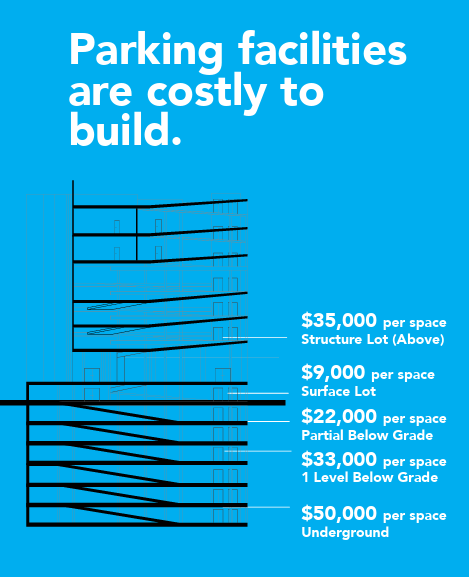
One-size-fits-all mandates often require parking to be overbuilt at great expense. Parking typically costs $22,000-$60,000 up-front, which translates to $125 - $500 per month per space including land, construction and operations. Ending mandates means residents & shopkeepers won’t have to pay for parking they don’t need.
Fewer empty parking lots means land can be repurposed for productive uses like homes and local businesses, or preserved to improve the tree canopy and reduce stormwater runoff.
What happens in cities after they repeal parking mandates?
Cities that remove parking mandates have seen lower housing costs, increased business development, and more diverse building types, with creative ways to provide parking.
Builders still install parking as needed, often meeting or exceeding previous requirements. However, removing mandates gives flexibility to dial the right amount of parking for each unique site and enable efficient parking arrangements like shared or off-site parking lots.
Like other cities, Atlanta’s current zones without parking mandates have not seen adverse effects, despite most people continuing to drive.
Atlanta already eliminated parking minimums near transit. Why repeal them city-wide?
Parking mandates don’t make sense anywhere. Communities without good transit have also seen great success for local redevelopment and lower housing costs due to the flexibility reforms enable. Full repeal also simplifies our zoning code, reducing administrative burden for the city and red tape blocking community improvements.
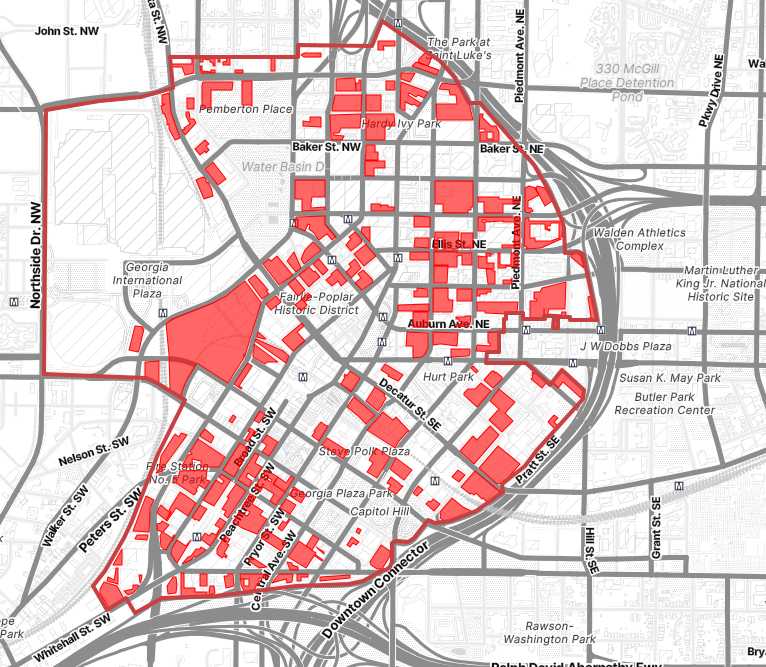
26% of central Atlanta is off-street parking, putting us near the bottom nationally for efficient urban land use. Image source: Parking Reform Network

The former Turner Field parking in Summerhill is being redeveloped into homes in a vibrant, more walkable cityscape. Image source: Carter.
How much evidence is there behind real-world parking reform?
Over 100 cities in the US have fully eliminated parking mandates. After seeing outcomes, communities implementing parking reforms have retained or expanded them.
Examples include:
Dunwoody, GA eliminated parking minimums city-wide in 2019, replacing them with maximums.
Birmingham, AL eliminated parking mandates city-wide in 2024.
Austin, TX eliminated parking mandates city-wide in 2023 as part of broader zoning reforms. As of 2025 rents have dropped 17% from their 2022 peak amid an influx of new housing supply.
Minneapolis and St. Paul, MN both removed parking mandates in 2021. Minneapolis saw typical rents of studio apartments fall 17% (from $1200 to $1000) in buildings without parking.
Denver, CO eliminated mandates city-wide in 2025 after a study found it would increase new housing construction by 12.5%.
Buffalo, NY saw significant new development after repealing parking mandates, with single-use projects providing more than previous requirements, and mixed-use projects providing less.
San Diego, CA saw a 5x increase in affordable housing, and an increase in market-rate housing, after adopting reforms including parking. The city later cut commercial parking mandates.
Seattle, WA saw builders saving $537 million ($30,000/unit) over 5 years after reducing mandates near transit and in centers. 2/3 of buildings provided more parking than mandated.
Sources:
1. Parking & Affordable Housing 2020/2021 Report. Fox Tuttle & Shopworks. https://shopworksarc.com/wp-content/uploads/2021/02/2021_Parking_Study.pdf
2. Todd Litman (2025), Parking Requirement Impacts on Housing Affordability. Victoria Transport Policy Institute. https://vtpi.org/park-hou.pdf
Dive deeper
Abundant Housing Atlanta hosted a webinar in February 2026 with Tony Jordan, President at Parking Reform Network. Alongside local housing policy experts, we connected the dots between zoning, transportation, and affordability.
Watch the recording on Abundant Housing Atlanta's YouTube channel to explore:
- How minimum parking requirements increase the cost of building housing
- How other cities are improving policies to improve affordability and mobility
- What changes Atlanta has proposed as part of the Zoning 2.0 rewrite – and what to watch for ahead
Subscribe
Learn about the pro-housing movement and how you can make housing more affordable near you!
Have a housing proposal that needs our support? Tell us about it!